




Receive for Free - Discover & Explore eNewsletter monthly with advance notice of special offers, packages, and insider savings from 10% - 30% off Best Available Rates at selected hotels. 
history
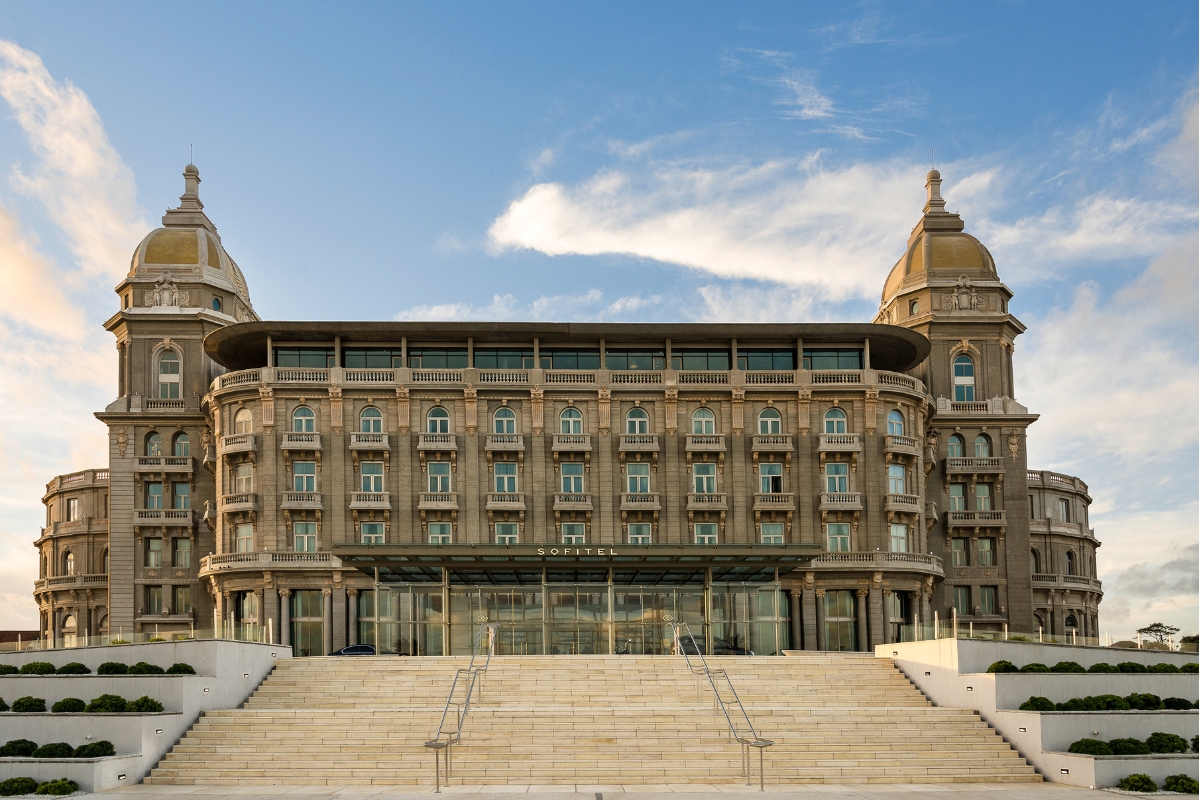
Discover Sofitel Montevideo Casino Carrasco and Spa, which was the first ever luxury hotel to open in all of Uruguay.

Sofitel Montevideo Casino Carrasco and Spa, a member of Historic Hotels Worldwide since 2025, dates to 1921.
VIEW TIMELINEAt the beginning of the early 20th century, prominent Uruguayan entrepreneur Alfredo Arocena purchased dozens of acres within a small, seaside hamlet just south of Montevideo known as “Carrasco.” Arocena had recognized the inherent beauty of its sweeping dunes and pine-forested groves, leading him to perceive a tremendous vision: he would transform Carrasco into the French Riviera of South America. To realize that dream, he founded the Balneario Carrasco S.A. for the purpose of establishing a picturesque resort community. The great Argentine landscaper Carlos Thays crafted awe-inspiring plans for the layout of new municipal blocks filled with elegant gardens and tree-lined streets. Central to those ambitious designs was the creation of an ornate boutique hotel, which Arocena had commissioned European architects Jacques Dunant and Gastón Mallet to build. They set about drawing different schematics for months, laying the foundation for what would become the first luxury hotel in Uruguay. Construction on the impressive edifice began in 1912, with its soaring façade gradually coming to dominate the local skyline. A brilliant combination of eclectic architectural styles constituted the hotel’s breathtaking appearance, notably Neoclassical and Baroque-inspired motifs. However, their masterful attention to detail materialized inside the structure, resulting in the installation of distinctive features like grand staircases, stained-glass windows, and Carrara-marble floors.
But the global outbreak of World War I profoundly impacted Arocena’s hotel development. Although Uruguay itself would not officially enter the conflict until 1917, its population had spent many years prior providing economic assistance to the Allies. In consequence, building materials became harder to obtain in places like Montevideo, which forced Arocena to halt his exciting project indefinitely. Frustrated, Arocena then decided to sell the unfinished building to the city, leaving its fate uncertain. Fortunately for the structure, civic leaders desired to see the hotel completed and took up the mantle to resume the endeavor. The building finally opened its doors shortly following New Year’s Day in 1921, thanks to the city officials’ dedicated support. Named the “Hotel Casino Carrasco,” the people of Montevideo found the experiences offered on-site to have been well worth the wait. The banquet halls were soon hosting all kinds of thrilling soirees, while the exquisite guestrooms were full every night. In fact, the hotel’s amazing ambiance quickly attracted considerable international attention, with foreign diplomats, intellectuals, and aristocrats vying to visit. The most renowned luminaries to book a room were legendary physicist Albert Einstein and famed playwright Federico García Lorca.
This incredible period of prosperity was not destined to last forever, as the Hotel Casino Carrasco started to lose clientele to more modern destinations starting in the 1950s. Care toward the building’s maintenance declined in turn, causing the deterioration of its once celebrated architectural character. Despite spirited attempts to prevent its further demise—including a communal campaign to declare the structure a Uruguayan National Historic Monument—the future of the iconic edifice seemed bleak. In 2009, a consortium called “Carrasco Nobile S.A.”—led by Codere and supported by Sofitel-affiliated investors—won a contract to thoroughly renovate the historic site. The group went on to work alongside the firm IAG Arquitectura to institute a comprehensive restoration that required the assistance of over 100 conservation experts and more than $75 million in funding. After four fruitful years, the restoration successfully concluded with a spectacular reopening ceremony attended by over 1,500 high-profile guests. Now known as “Sofitel Montevideo Casino Carrasco and Spa,” the hotel stands today as a stunning testament to Uruguay’s rich cultural heritage. Its storied past continues to captivate visitors from around the world, offering an experience that seamlessly blends historic grandeur with contemporary luxury.
-
About the Location +
The story of Montevideo began on the windswept shores of the Río de la Plata, where tales of ambition, conflict, and resilience played out over the course of generations. But in the early 18th century, this stretch of coastline was little more than a contested frontier between competing empires. Spain and Portugal, locked in a struggle for dominance in South America, ambitiously eyed the region. The Portuguese had already established a foothold in nearby Colonia del Sacramento, and Spain, fearing encirclement, resolved to create a colony along the Río de la Plata. In 1724, a small Spanish expedition under Bruno Mauricio de Zabala founded a settlement upon a natural bay, which possessed a harbor so sheltered that it seemed destined to become a maritime stronghold. They called it “Montevideo,” a name whose origins remain shrouded in mystery—whatever its genesis, the word would soon echo across oceans. From its inception, Montevideo was a city born of strategy. Its fortifications rose against the horizon, bastions of stone and cannon meant to guard against Portuguese incursions and the ever-present threat of roaming corsairs. Beyond its military utility, the settlement started to attract families, artisans, and merchants, too, who were drawn by its potential for economic opportunity. The bay gradually emerged as a hive of maritime activity, as its waters were dotted with ships bearing goods from Europe and the interior. Cattle ranching flourished on the surrounding pampas, while hides, tallow, and salted meat flowed through Montevideo’s port. Life in those early decades was harsh, but the seeds of a cosmopolitan society had already taken root.
As the 19th century dawned, Montevideo found itself swept into the maelstrom of independence movements that convulsed Latin America. The fall of Spanish authority unleashed a struggle for power in the Río de la Plata region, and Montevideo became both prize and pawn in a series of wars that would shape its destiny. In 1810, news of the revolution in Buenos Aires reached across the river, igniting hopes and fears. For a time, Montevideo remained loyal to the Spanish crown, a bastion of royalist resistance against the insurgent forces of the United Provinces. However, after years of blockade, the city eventually capitulated in 1814. The Portuguese, then saw their chance and moved to occupy the city three years later. Now a part of Brazil, the Portuguese presence eventually stirred fierce resentment among the population. In 1825, a band of patriots went on to launch a daring campaign to reclaim their land, igniting the much wider Cisplatine War. When the fighting finally ended, it had produced in a compromise: Uruguay would emerge as an independent nation, with its sovereignty guaranteed under British diplomacy. Montevideo now stands as the capital of a fragile republic, tasked with forging unity from diversity out of chaos. The latter half of the 19th century was subsequently an era of transformation, yet it offered little respite from strife. Political factions—the Colorados and Blancos—vied for supremacy, their rivalry plunging the country into intermittent civil wars. Montevideo became a stage for these dramas, its streets echoing with the tramp of hostile soldiers. Montevideo’s resilience earned it a reputation as a city of endurance, a place where liberty could withstand any tumult.
When peace returned, it brought with it the promise of progress. Europeans poured into Montevideo, infusing the city with new skills, traditions, and aspirations. Elegant boulevards and plazas replaced colonial streets, and Neoclassical facades reflected the nascent success of local commerce. The port thrived as a conduit for wool, meat, and grain, which anchored Uruguay’s export economy for years to come. Railways stitched the hinterland to the capital, and theaters, cafes, and clubs blossomed, nurturing a vibrant cultural life. The 20th century brought further changes, as Uruguay embraced social reforms that set it apart from its neighbors. Thanks to leaders like José Batlle y Ordóñez, the nation pioneered progressive policies—universal education, secular governance, and labor protections—that gained acclaim as a model republic. Montevideo in turn mirrored these ideals in its urban fabric and civic spirit. History is seldom linear though, and Montevideo was not immune to the tempests of the modern age. The middle of the century saw political tensions, culminating in authoritarian rule during the 1970s. Even in those bleak years, the spirit of Montevideo endured, sustained by the quiet defiance of its people and the enduring rhythms of daily life. With the return of democracy, Montevideo reclaimed its status as one of the continent’s preeminent destinations. Today, Montevideo is a city that wears its history with pride. Its skyline blends colonial towers with modern high-rises, and its streets pulse with art and music. Indeed, Montevideo is more than a capital—it is a symbol to the enduring power of the people who continue to live upon the shores of the Río de la Plata.
-
About the Architecture +
While Sofitel Montevideo Casino Carrasco and Spa displays many distinctive architectural styles today, the most prominent happens to be Classical Revival. Also known as “Neoclassical,” Classical Revival architecture itself is among the most common architectural forms seen throughout the world today. This wonderful architectural style first became popular in Paris, namely among French architectural students who had studied in Rome during the late 18th century. Upon their return home, the architects began emulating aspects of earlier Baroque aesthetics into their own designs before finally settling on Greco-Roman examples. Over time, the embrace of Greco-Roman architectural themes spread across the globe, reaching destinations like Germany, Spain, and Great Britain. As with the equally popular Revivalist styles of the same period, Classical Revival architecture found an audience for its more formal nature. It specifically relied on stylistic design elements that incorporated components like the symmetrical placement of doors and windows, as well as a front porch crowned with a classical pediment. Architects would also install a rounded front portico that possessed a balustraded flat roof. Pilasters and other sculptured ornamentations proliferated across the façade of the building, too. The most striking features of buildings designed with Classical Revival-style architecture were massive columns that displayed some combination of Corinthian, Doric, or Ionic capitals. With its Greco-Roman temple-like form, Classical Revival-style architecture was considered most appropriate for municipal buildings like courthouses, libraries, and schools. But the form found its way into more commercial uses, including banks, department stores, and hotels. Examples of the form can still be found throughout many major cities as well, including London, Paris, and New York City.
However, the building also showcases a brilliant blend of Baroque Revival-style architecture, otherwise known as “Second Empire,” in France where it originated. Baroque Revival architecture was specifically meant for larger structures that could easily showcase its ornate features and grandiose materials. Architects, business owners, and other professionals who embraced the form believed that it represented the best of modernity and human progress. This idea especially found an audience in America, where society was perceived to be on an upward path of collective mobility. (In fact, the architecture had become so enmeshed in American society that some took to calling it “General Grant” style.) The form looked like the equally popular Italianate-style, in which it embraced an asymmetrical floor plan that was rooted to either a “U” or “L” shaped foundation. The buildings usually stood two to three stories, although some commercial structures—like hotels—exceeded that threshold. Large ornate windows proliferated across the facade, while a brilliant wraparound porch occasionally functioned as the main entry point. The porches would also have several outstanding columns, designed to appear smooth in appearance. Every window and doorway featured decorative brackets that typically sat underneath lavish cornices and overhanging eaves. Gorgeous towers known and cupolas typically resided toward the top of the building, too. But the aesthetic broke from Italianate in one major way—the appearance of the roof. Architects always incorporated a mansard-style roof onto the building, which consisted of a four-sided, gambrel-style structure that was divided into two different slopes. Set at a much longer, steeper angle than the first, the second slope often contained many beautiful dormer windows. The mansard roof became a principal component to the form after a few French architects starting using it for their own designs. They had specifically sought to copy the mansard roof of The Louvre, which the renowned François Mansart had created back at the height of the French Renaissance.
-
Famous Historic Guests +
Albert Einstein, Nobel Prize winning physicist known for his role in developing quantum theory.
Frederico García Lorca, playwright known for his works like Blood Wedding, Yerma, and The House of Bernarda Alba.