



Receive for Free - Discover & Explore eNewsletter monthly with advance notice of special offers, packages, and insider savings from 10% - 30% off Best Available Rates at selected hotels. 
history
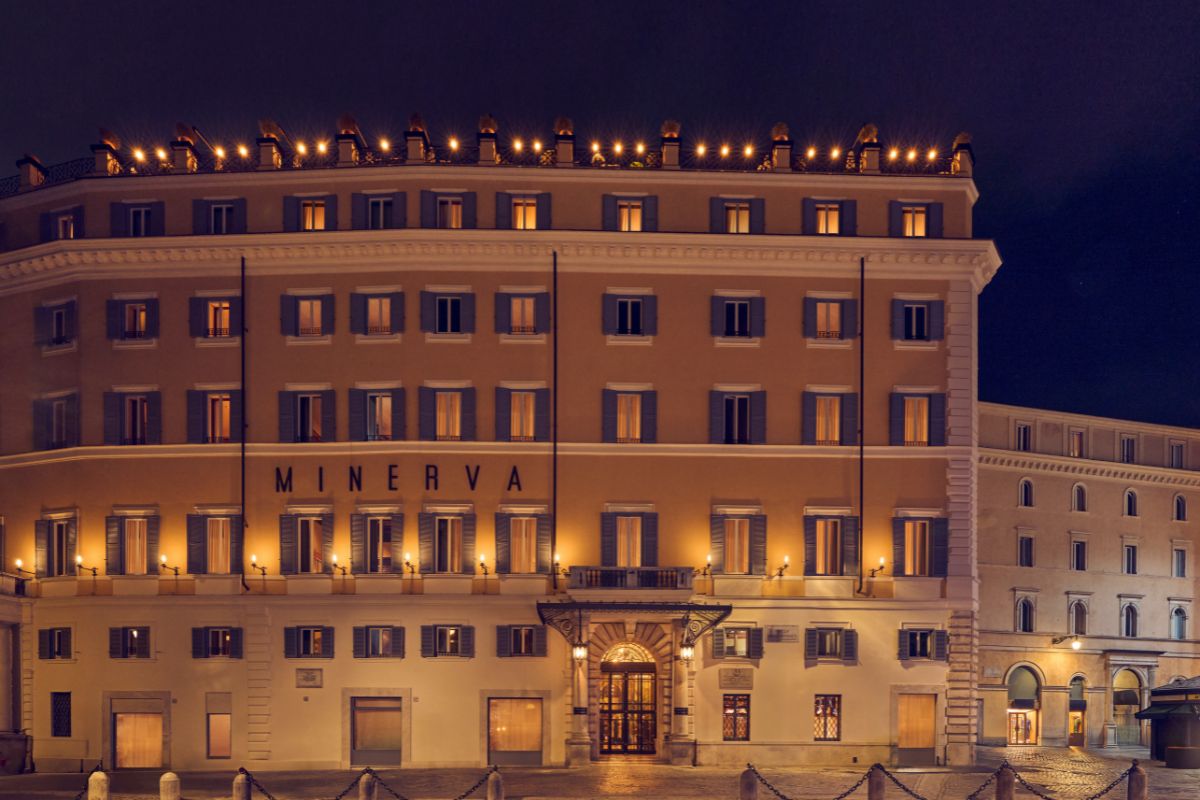
Discover Orient Express La Minerva, which has hosted illustrious intellectual luminaries like Herman Melville, George Sand, and Stendhal.

Orient Express La Minerva, a member of Historic Hotels Worldwide since 2026, dates to 1620.
VIEW TIMELINE
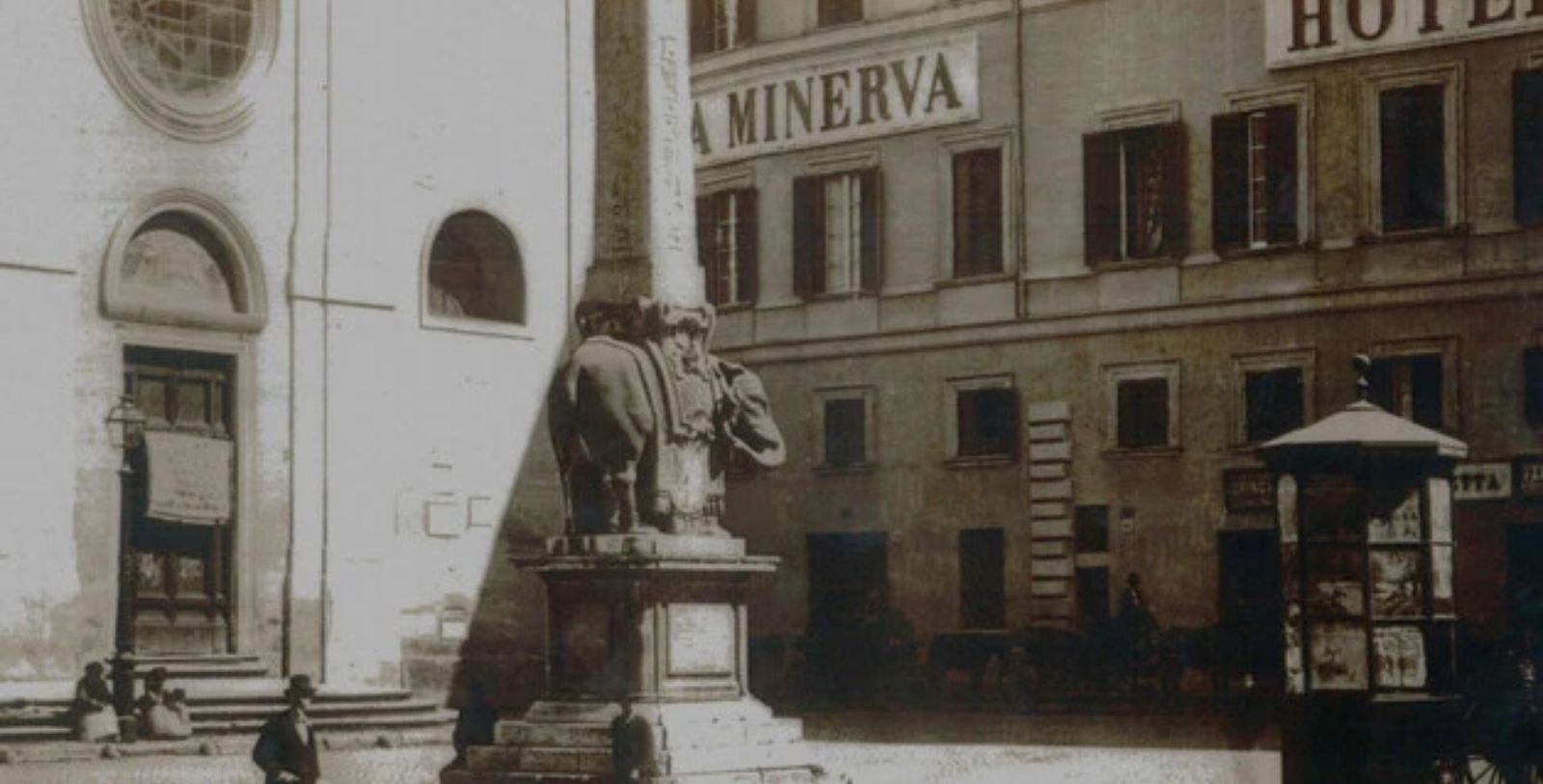
Long before it carried the storied name “Orient Express La Minerva,” the building that now constitutes the hotel was a Renaissance-era mansion called “Fonseca Palace.” Named after the Portuguese family that first lived at the location, the palace became a renowned landmark given its wonderful Baroque architecture. Around the beginning of the 19th century, Rome began to receive a rising number of tourists who were captivated by its ancient cultural institutions. Fonseca Palace offered an ideal vantage point from which to explore those sites, prompting ambitious entrepreneurs to transform it into a resplendent hotel. Debuting as the “Grand Hotel de la Minerve” in 1811, the reimagined palace soon emerged as one of the most exclusive havens in Europe. Indeed, countless young aristocrats routinely sought out accommodation within the building amid their educational journeys across the continent, a phenomenon remembered as the “Grand Tour.” But the revered hotel had started entertaining illustrious intellectuals, given its proximity to numerous awe-inspiring sights situated throughout Rome. Noted American writer Herman Melville frequented the hotel, as did French authors Stendhal and George Sand. In fact, Stendhal had used his time spent at the Grand Hotel de la Minerve to help write his celebrated Promenades dans Rome ("Roman Walks").
Centuries later, the palace attracted the attention of Orient Express—known for its storied rail voyages since 1883—and Italian developer Arsenale Groupe. Recognizing the building’s incredible heritage, the two groups decided to use the site to host an exquisite, ultra-luxury destination. The choice spoke to a deeper desire to create a physical embodiment of the golden age of travel, rooted in authenticity and history. Nevertheless, they entrusted the restoration to talented architect and artist Hugo Toro. Hailed for bridging modern finesse with historical reverence, Toro approached the project as though he was reawakening the palace rather than renovating it. His resulting design subsequently saw refurbished walnut wood, brushed metals, and Rosso Verona marble recall the lost artistry of handcrafted travel trunks and polished train carriages. However, Toro’s work also attempted to translate the greater ethos of Orient Express—the slow, intentional movement through landscapes and cultures—into architectural form. Corridors evoked the polished elegance of opulent train interiors, while bedrooms featured fine linens that mirrored the ones once used in Orient Express sleeper cars.
The palace’s rebirth as “Orient Express La Minerva” marked the official opening of the brand’s first contemporary hotel. The event also symbolized a fusion of eras, the historic weight of a medieval palace blending seamlessly with the cultural memory of the legendary trains that had inspired its revitalization. Inside, guests have since gathered beneath the dramatic skylight of La Minerva Bar, a space guarded by a masterfully sculpted statue of the goddess Minerva. Just above, the rooftop restaurant Gigi Rigolatto Roma continues to capture the spirit of the Italian Riviera, pairing panoramic views alongside a lively, effortless sense of fulfillment. Throughout its long life, the building has truly been a participant in Rome’s evolution. As the Fonseca Palace, it bore the imprint of aristocratic families and the greater cultural resonance of 17th-century Roman society. As a hotel during the 1800s, it then embraced the adventurous intellectuals of the Grand Tour. Now, as Orient Express La Minerva, it stands as a testament to the enduring power of place—a structure that has shed identities without losing its soul. Guests today experience the building not as a static monument but as an evolving story, one that honors its layered past while embracing newer chapters. In this way, Orient Express La Minerva is more than a hotel—it is representative of Rome’s very essence.
Centuries later, the palace attracted the attention of Orient Express—known for its storied rail voyages since 1883—and Italian developer Arsenale Groupe. Recognizing the building’s incredible heritage, the two groups decided to use the site to host an exquisite, ultra-luxury destination. The choice spoke to a deeper desire to create a physical embodiment of the golden age of travel, rooted in authenticity and history. Nevertheless, they entrusted the restoration to talented architect and artist Hugo Toro. Hailed for bridging modern finesse with historical reverence, Toro approached the project as though he was reawakening the palace rather than renovating it. His resulting design subsequently saw refurbished walnut wood, brushed metals, and Rosso Verona marble recall the lost artistry of handcrafted travel trunks and polished train carriages. However, Toro’s work also attempted to translate the greater ethos of Orient Express—the slow, intentional movement through landscapes and cultures—into architectural form. Corridors evoked the polished elegance of opulent train interiors, while bedrooms featured fine linens that mirrored the ones once used in Orient Express sleeper cars.
The palace’s rebirth as “Orient Express La Minerva” marked the official opening of the brand’s first contemporary hotel. The event also symbolized a fusion of eras, the historic weight of a medieval palace blending seamlessly with the cultural memory of the legendary trains that had inspired its revitalization. Inside, guests have since gathered beneath the dramatic skylight of La Minerva Bar, a space guarded by a masterfully sculpted statue of the goddess Minerva. Just above, the rooftop restaurant Gigi Rigolatto Roma continues to capture the spirit of the Italian Riviera, pairing panoramic views alongside a lively, effortless sense of fulfillment. Throughout its long life, the building has truly been a participant in Rome’s evolution. As the Fonseca Palace, it bore the imprint of aristocratic families and the greater cultural resonance of 17th-century Roman society. As a hotel during the 1800s, it then embraced the adventurous intellectuals of the Grand Tour. Now, as Orient Express La Minerva, it stands as a testament to the enduring power of place—a structure that has shed identities without losing its soul. Guests today experience the building not as a static monument but as an evolving story, one that honors its layered past while embracing newer chapters. In this way, Orient Express La Minerva is more than a hotel—it is representative of Rome’s very essence.
-
About the Location +
Rome, the Eternal City, has stood along the shores of the Tyrrhenian Sea for thousands of years. Settled millennia ago, the city has since emerged as the third most populous metropolis within the European Union. It is also an incredibly popular destination for cultural heritage travelers, as it hosts some ten million tourists every year. And for good reason, too, for Rome's heritage is quite extensive. While scholars today often have difficulty pinpointing an exact date for Rome’s founding, legends persist that the city first appeared in the 8th century BC. The earliest stories attest that Romulus—a son of the god Mars—created the settlement in his own honor, after killing his twin brother Remus, whom he had seen as a rival. Actual archeological evidence suggests that the city came to exist over generations, settled by disparate bands of ancient people that included the Latins, the Sabines, and the Etruscans. They all administered Rome as petty kings, elected via a large body of local noblemen called the “Senate” that gathered within a complex known today as the “Roman Forum.” Rome expanded steadily for centuries due to their influence, growing from the incorporation of neighboring communities into its own borders. Soon enough, the Rome of antiquity had grown to encompass seven legendary hills: Esquiline, Palatine, Aventine, Capitoline, Quirinal, Viminal, and Caelian. But a popular uprising against the monarchy erupted in 509 BC, resulting in the establishment of a republic managed under the auspices of the Senate. The Senate, in turn, annually elected two magistrates to handle the city government’s executive tasks, although candidates were often picked from among the social elites. Nevertheless, the Senate’s control over the city encountered protests from the common folk, who often fought bitterly for more representation. The Senate eventually acquiesced some of its power in the face of such antagonism, granting the plebians the right to veto legislation through a special group of organizations known as the “tribunes.”
Conquering the entire Italian peninsula by the 3rd century BC, the Romans (as they were now called) started to challenge other regional powers throughout the Mediterranean. The greatest of those conflicts were the “Punic Wars,” which pitted Rome against the mighty African city-state of Carthage. While both sides saw their fair share of victories—including the Carthaginian general Hannibal’s famous sacking of Rome—the Punic Wars ultimately ended as a resounding victory for the Romans. Including Carthage itself, Rome controlled large swathes of new territory in places like Spain, Sicily, and Sardinia as a result. Now the dominant socioeconomic entity in the area, Rome began to expand even further in the direction of ancient Greece and the Middle East. But the nature of Rome’s internal politics had grown more divisive, especially as the wealth obtained from Rome’s wars did not reach the city’s lower social classes. Despite attempts at reform, the Roman Senate encountered increasingly difficulty to regulate society. Opportunistic warlords emerged as such, who used their vast armies and political connections to vie for influence. One such general, Pompey, eventually seized the city during the 1st century BC, ruling through an uneasy alliance with two other prestigious military commanders named Marcus Licinius Crassus and Julius Caesar. A power struggle quickly developed between Pompey and Caesar, though, especially in the aftermath of Crassus’ untimely death in battle. Using the influence he obtained from his successful campaigns in Spain and France, Caesar eventually overthrew Pompey in a brief, yet destructive civil war.
Cesar declared himself dictator of the republic in 45 BC. His rule proved to be brief, though, as he was murdered during an assassination plot remembered infamously as the “ides of March.” In Caesar’s absence, his great-nephew and heir, Octavian, managed to seize the reins of government. Assuming the title of “Augustus,” Octavian elevated himself to the status of Rome’s emperor. But he also retained the Senate, which quickly built a cult of personality around him. In fact, the Senate deified Octavian upon his death, thus, establishing the long tradition of hailing the emperor as an incarnated god. Despite brief moments of instability, the Roman Empire flourished for centuries thereafter. Its borders expanded rapidly, too, encompassing locations as far away as southeastern Europe and the British Isles. Rome itself served as the epicenter for this vast realm, becoming replete with all kinds of beautiful municipal buildings and glorious monuments that reflected the empire’s prestige. Among the most outstanding structures built included the Pantheon, the Colosseum, and the Marcati di Traiano (Trajan’s Market). But decline eventually befell the historic Roman Empire, starting with the corruption wrought by Emperor Commodus in the late 2nd century AD. Infighting became frequent yet again, fracturing Rome’s increasingly fragile community. One of Commodus’ distant successors, Constantine, even decided to relocate the empire’s capital to Constantinople (Istanbul today) in an attempt to stop the decay. The Roman Empire split nonetheless during Constantine’s reign, with Rome becoming the capital of the Western Roman Empire. While the eastern half endured as Byzantium for some time, Rome and its reduced western dominions were constantly assailed by Germanic tribes from the north. The Western Roman Empire finally collapsed in the 5th century AD, with its many provinces reverting to the status of independent kingdoms. Rome itself suffered greatly from the continued warfare, its population shrinking significantly by the onset of the Middle Ages.
The city’s politics then fell under the sway of the Catholic Church, which had been elevated to the status of an official religion by Emperor Constantine years before. Still, contemporary European powers at the time—including the Franks, the Lombards, and the Byzantines—all fought over Rome. As such, the church sought to accommodate the various people that sought to incorporate Rome into its own sphere of influence. Having defeated the Lombards, the Frankish king Pepin the Short eventually bestowed complete local authority onto the Catholic Pope and made Rome the capital of the “Papal States.” Over the next several centuries, the papacy would rule Rome through a complex political system it shared with the city’s nobility. But peace was often short-lived in Rome, especially once the power of the Franks waned considerably at the height of the Middle Ages. The Catholic Church and the local aristocrats clashed regularly, making the city an easy target for foreign armies. But long-term stability finally affected Rome in the 15th century, after Otto Colonna became the new pope. His election marked the beginning of the Renaissance in Rome, as the many popes that followed him began to patronize the arts. Among the historic intellectuals that the Roman Catholic Church sponsored included Michelangelo, Raphael, Ghirlandaio, and Sandro Botticelli. Many of those artists even created great works for the Catholic Church, appearing in buildings like the Cappella Sistina (Sistine Chapel) and Basilica di San Pietro (St. Peter’s Basilica). Rome soon emerged as the heart of the Renaissance, supplanting cities like Florence where it had originally started. But the era was not without its faults, for many Catholic officials were caught up in scandals ranging from corruption to infidelity. Their actions helped spawn the Reformation, which questioned the authority of the Catholic Church throughout Europe. In response, Rome became the bastion for the Counter-Reformation that sought to rehabilitate the papacy’s prestige. Ostentatious architectural styles and extravagant art forms proliferated, giving birth to many gorgeous Baroque structures that still stand in Rome today.
The Napoleonic Wars of the late 18th and early 19th centuries significantly impacted Rome. Napoleon Bonaparte’s armies conquered the Papal States and made Rome the capital for one of his satellite, the Roman Republic. While the republic was short lived, its legacy inspired future generations of revolutionaries to establish a unified Italian state. As populist revolutions swept across Europe in 1848, a number of Italians attempted to revive the Roman Republic amid a larger campaign to unify the entire peninsula into one nation. Many important revolutionaries fought on behalf of the new government, including the famed general Giuseppe Garibaldi. While the second republic dissolved as well, Garibaldi and other likeminded Italian patriots would eventually found the Kingdom of Italy two decades later. Rome was deemed the capital for the kingdom, with the new Italian monarch, Victor Emmanuel II, headquartered in the city. But the papacy resisted its formation, prompting the new national government to officially wrestle control away by the 1870s. (The papacy would eventually gain independence from Italy in 1929, forming its own nation within Rome called the “Vatican City.”) In the years that followed, Rome was the center for the brief Italian Empire organized due to the political machinations of Benito Mussolini. Mussolini’s fascist state would ultimately fight on the side of the Axis powers during World War II, until Italian partisans ousted the dictator and forced Italy to switch sides in 1943. Rome was even occupied by the Allies a year later, with the first soldiers entering the city just two days before the invasion of Normandy. Rome has since rebounded both economically and culturally, serving as the capital for one of Europe’s most dynamic democracies. Its great ancient history continues to enchant people across the globe, which has even inspired the United Nations to protect large portions of its downtown as a UNESCO World Heritage Site
-
About the Architecture +
Originally built as a resplendent palace, the most historic portions of Orient Express La Minerva showcase Baroque architecture. Baroque architecture can trace its roots back to the start of the 17th century when French architects began to practice the style en masse. The architectural form specifically materialized in the wake of the Mannerist design aesthetics that had preceded it at the height of the Renaissance. The French had begun to mimic a new architectural school of thought that had debuted further south in the Italian Peninsula. The Vatican had grown weary of its declining influence across Europe amid the Protestant Reformation and sought innovative ways to demonstrate its cultural power. One of the many avenues that the church embraced was the use of architecture as a means of displaying its wealth and prestige. As such, the Italian architects under its employ started creating massive structures that placed a greater emphasis on opulence and grandeur. Inspired by the movement, many French and many other European noblemen incorporated similar design principles into their own buildings. What made Baroque so attractive to the European aristocracy was its use of grandiose details to achieve an awe-inspiring ambiance. The style relied on symmetry, in which highly stratified floorplans granted a sense of hierarchy and order. Large ornate windows proliferated across the facade, while a brilliant wrap-around porch occasionally functioned as the main entry point. The porches would have outstanding columns, designed to appear smooth in appearance. Every window and doorway featured decorative brackets that typically sat underneath lavish cornices and overhanging eaves. Gorgeous towers known and cupolas typically resided toward the top of the building, too.
However, the more contemporary portions of the building display an ornate combination of Art Deco-inspired motifs. Art Deco architecture itself is among the most famous architectural styles in the world. The form originally emerged from a desire among architects to break with the past architectural precedents that had dominated for generations. Instead, professionals within the field aspired to forge their own design principles. More importantly, they hoped that their ideas would better reflect the technological advances of the modern age. As such, historians today often consider Art Deco to be a part of the much wider proliferation of cultural “Modernism” that first appeared at the dawn of the 20th century. Art Deco as a style first became popular in 1922, when Finnish architect Eliel Saarinen submitted the first blueprints to feature the form for contest to develop the headquarters of the Chicago Tribune. While his concepts did not win over the judges, they were widely publicized, nonetheless. Architects in both North America and Europe soon raced to copy his format in their own unique ways, giving birth to modern Art Deco architecture. The international embrace of Art Deco had risen so quickly that it was the central theme of the renowned Exposition des Art Decoratifs in Paris a few years later. Architects the world over fell in love with Art Deco’s sleek, linear appearance as defined by its series of sharp setbacks. They adored its geometric decorations that featured motifs like chevrons and zigzags. But despite the deep admiration people felt toward Art Deco, interest in the style gradually dissipated throughout the mid-20th century. Many examples of Art Deco architecture survive today though, with some of the best located in such places as New York City, London, Paris, and of course, Rome.
-
Famous Historic Guests +
Amantine Lucile Aurore Dupin de Francueil, noted novelist and journalist best remembered today by her pen name “George Sand.”
Herman Melville, author known for novels like Typee, Billy Budd, and Moby-Dick.
Stendhal (Marie-Henri Beyle), author best remembered for writing Le Rouge et le Noir and La Chartreuse de Parme.
Thomas Bernhard, writer best known for novels like the Loster, Woodcutters, and Old Masters.
Pablo Picasso, Cubist artist known for such works like Les Demoiselles d'Avignon, The Weeping Woman, and Guernica.
Pope Pius IX, former head of the Catholic Church (1846 – 1878).
-
Women in History +
Amantine Lucile Aurore Dupin de Francueil: Amantine Lucile Aurore Dupin de Francueil, better known to history as “George Sand,” moved through the 19th century with a defiant grace that electrified the contemporary literary world. Born to an aristocratic French family in 1804, she learned early that her life would resist simple classification. Her childhood unfolded between the rigidity of her grandmother’s estate at Nohant and the freer, more bohemian influence of her father, whose sudden death left a lasting imprint on her sense of independence. Even as a girl, she wandered the woods around Nohant, fascinated not only by the natural world but also the freedom it offered from cultural expectations that were ever present. Nevertheless, her eventual marriage to François Casimir Dudevant proved to be stifling, fueling her transformation into an internationally celebrated author. Indeed, she had left the constraints of Dudevant’s household within a few years, venturing to Paris with the determination to carve out an existence defined by her intellect. Yet Parisian society had expectations of its own. A woman seeking to publish serious literature at the time found doors closed before they could be opened. It was in this crucible that Aurore Dupin forged the pseudonym “George Sand” in 1832.
As George Sand, she wrote with a clarity and emotional depth that startled critics who had never imagined a woman could wield such moral authority through prose. Her novels—lush, philosophical, and fiercely humane—wove together tales of rural life, political idealism, and the struggles of ordinary people. She championed workers and farmers with a tone that sounded both conciliatory and timeless. She lived as she wrote, too, embracing a lifestyle of artistic and political engagement that scandalized her contemporaries: wearing men’s clothing for comfort; smoking cigars in public; and maintaining friendships, mentorships—even romances—with some of the era’s greatest artists (including composer Frédéric Chopin). Beyond her body of work, Sand’s most enduring legacy was her commitment to the then-revolutionary belief that men and women alike deserved intellectual freedom. Nevertheless, she eventually returned to Nohant late in life, where she continued to write with undiminished vigor. There, the woman who had once defied every aspect of her regal status found peace among the landscapes that had shaped her earliest dreams. Amantine Lucile Aurore Dupin de Francueil died in 1876, but her voice has since echoed across centuries, reminding readers that courage sometimes begins with the refusal to remain silent.