





Receive for Free - Discover & Explore eNewsletter monthly with advance notice of special offers, packages, and insider savings from 10% - 30% off Best Available Rates at selected hotels. 
history
Discover The St. Regis Washington, D.C., which was once the place where U.S. President Harry S. Truman sought to relax in private throughout his two terms in office.
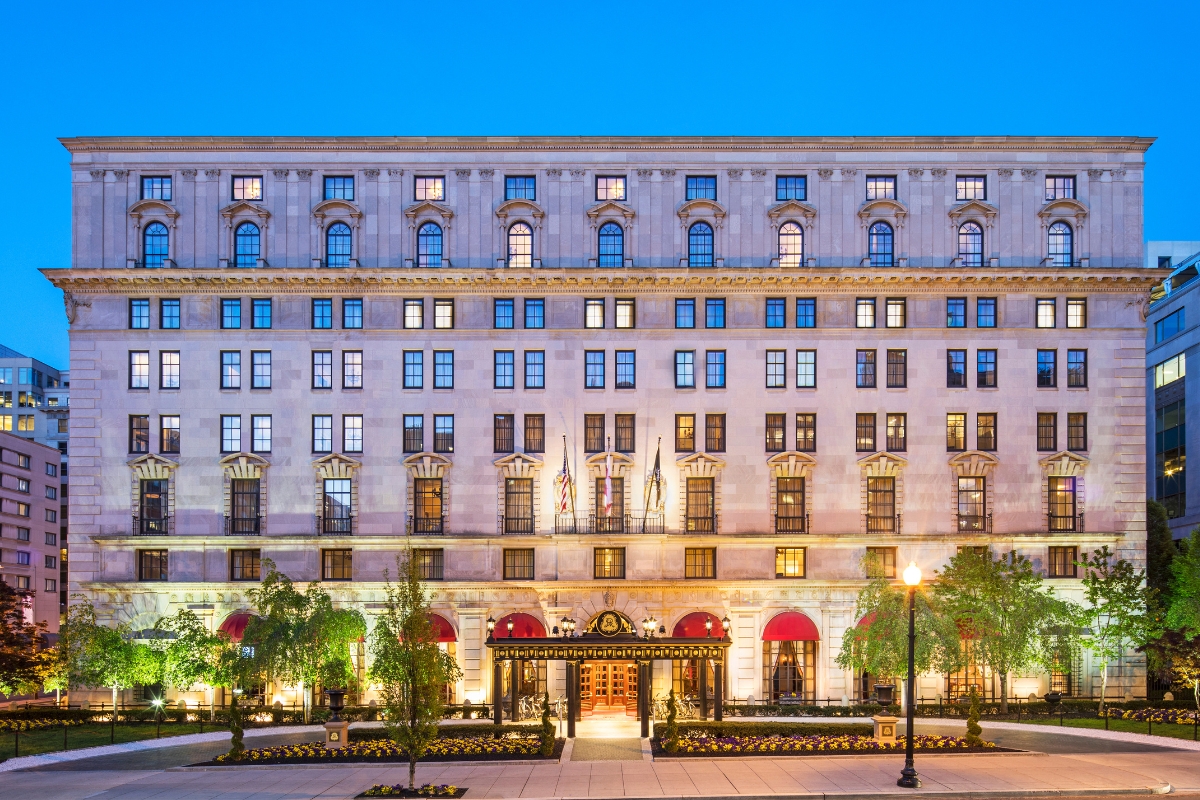
Located two blocks away from the White House, The St. Regis Washington, D.C. is one of the most prestigious destinations to visit in the nation’s capital. Countless luminaries from across the world have vied to experience its array of sophisticated amenities and heralded service, in turn establishing an enviable reputation that has endured for generations. The origin of this illustrious identity goes back to the hotel’s very founding during the early 20th century, a time when the District of Columbia was undergoing incredible transformations. Dozens of gorgeous buildings had started to emerge all over downtown Washington, driven by the ever-growing influence and vitality of the federal government. Among the magnificent structures to debut were the commercial edifices of prominent real estate developer Harry Wardman. Already the proprietor of numerous upscale apartment complexes, Wardman decided to build a marvelous hotel that would rival the finest European venues then in operation. To make his dream a reality, the ambitious entrepreneur hired the talented Armenian architect Mihran Mesrobian to oversee its lavish design. Mesrobian subsequently crafted an excellent multistory structure that soon came to dominate the local skyline.
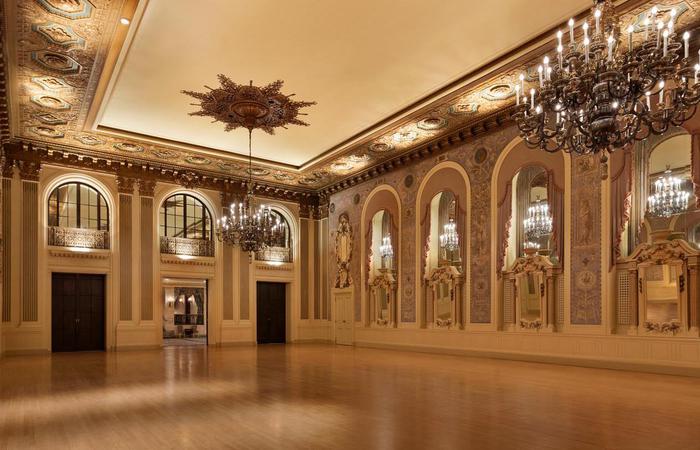
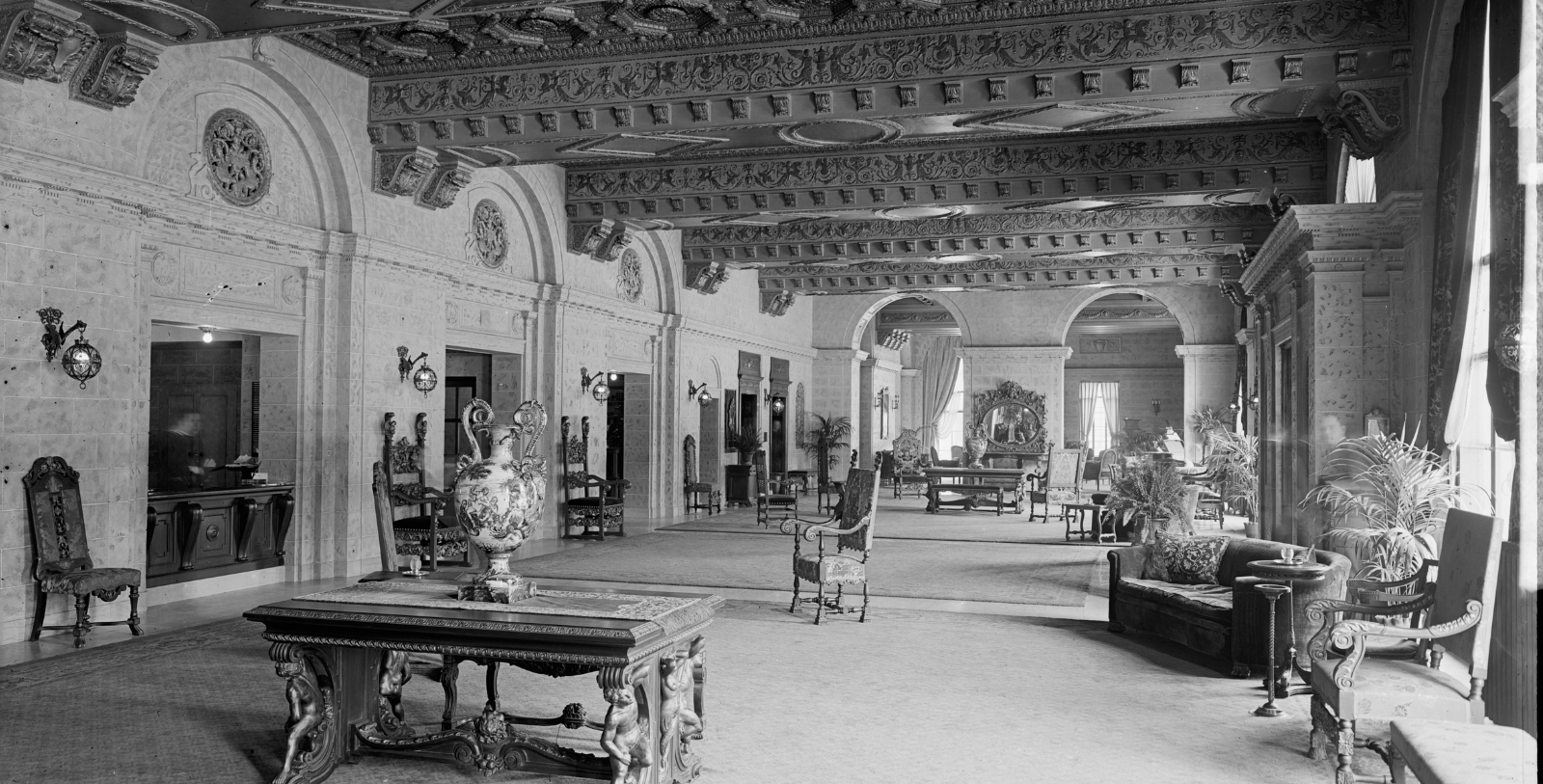
Beautiful Beaux-Arts motifs molded the exterior façade, such as decorative stone balustrades, wonderful wrought-iron detailing, and intricately carved cornices sculpted in a stunning egg-and-dart pattern. Such breathtaking architecture appeared inside, too, with the grand lobby serving as the anchor for the entire interior layout. Large double-doors guided potential guests into the space, which featured glistening marble floors, towering classical pillars, and a sprawling coffered ceiling that conveyed a theatrical sense of opulence. In 1926, Harry Wardman finally opened his spectacular new business as the “Carlton Hotel” to great acclaim. The hotel quickly became a lively social gathering spot, hosting all kinds of thrilling soirees and galas within a matter of months. Although Wardman was later forced to sell the Carlton Hotel around the Great Depression, the site maintained its status as an elite location for many years after. For instance, Perle Mesta—the famed Washington hostess—held her legendary galas as well as her women’s suffrage events at the Carlton Hotel, which attracted the city’s most prevalent people. Renowned Hollywood celebrities were also spied gracing the hotel with their presence, like Elizabeth Taylor, Audrey Hephurn, and Joan Crawford. Some of those distinguished guests briefly called the building home, too, such as Secretary of State Cordell Hull and the enigmatic aviator Howard Hughes.
Indeed, Hull conducted much of his diplomatic activities on-site during World War II, while Hughes would generously host uniformed servicemen assigned to protect the city. Even U.S. Presidents were regular patrons of the Carlton Hotel, including U.S. President Harry S. Truman, who often had to enter through a secluded side window to avoid unwanted attention. Amazingly, this surging popularity managed to endure the rest of the century, thanks to a series of extensive renovations that successfully preserved its iconic character. The best symbol of its lasting appeal was the decision of President Ronald Reagan to frequently have his hair cut by the hotel’s barber, Milton Pitts, throughout the 1980s. Then following an extensive rehabilitation that brilliantly revitalized its contemporary offerings, the hotel officially rebranded as “The St. Regis Washington, D.C.” becoming the first hotel outside New York to bear the prestigious “St. Regis” name. Now listed in the U.S. National Register of Historic Places, this legendary historic hotel has remained a revered landmark due to its impressive legacy of hospitality. But The St. Regis Washington, D.C. is more than just a hotel, it is a living monument to the city’s expansive history. From hosting U.S. Presidents to acting as a backdrop for Hollywood glamour, The St. Regis Washington, D.C., continues to embody the spirit of luxury that has defined it for a century.
-
About the Location +
The St. Regis Washington, D.C., is located within the renowned Sixteenth Street Historic District, one of the most active areas in all of Washington, D.C. While the area today is among the city’s most traveled, it went largely uninhabited for many years following its initial development in the 1790s. Sixteenth Street was specifically a key component to Pierre Charles L’Enfant’s vision for Washington, in which it would serve as an important thoroughfare that would divert traffic from today’s Florida Avenue to the White House. Nevertheless, L’Enfant’s plan did not happen, as the road consisted of a wide, dirt path until the outbreak of the American Civil War. Buildings remained sparse as well, with just a handful of structures lining their streets. The greatest buildings developed at the time was the beautiful St. John’s Episcopal Church, whose architect, Benjamin Henry Latrobe, had worked on the U.S. Capitol Building nearby. Sixteenth Street’s fortunes changed dramatically in the latter half of the 19th century, when it became a popular neighborhood for the residences of many powerful politicians and dignitaries. Among the most prominent individuals to construct a residency along the street were U.S. Senators, including George H. Pendleton and J. Donald Cameron. Henry Adams, the renowned diplomat and son of President John Quincy Adams, had a house in the area, as did President Abraham Lincoln’s personal secretary, John Hay. The founder of the Washington Post, Stilson Hutchins, also lived in the vicinity of Sixteenth Street, while Alexander Graham Bell rented commercial space for his “Bell Experimental School.” Vice President James S. Sherman called the locale home after he moved into a gorgeous manor in 1883. Sixteenth Street has retained its prestigious reputation, as it is filled with many outstanding restaurants, storefronts, and office spaces.
The hotel is just a few blocks away from the illustrious Lafayette Square Historic District. Anchored by the eponymous Lafayette Square, this famous neighborhood is home to such historical landmarks as the Blair House, the Decatur House, and the Eisenhower Executive Office Building. Lafayette Square is just a short walk from additional iconic locations, too, like the White House, The Ellipse, and the National Mall. In the words of the U.S. Department of the Interior: “Its statues remind visitors of the struggle to achieve a popular form of government, and it has often been a meeting place for those wishing to bring important issues to the immediate attention of the Chief Executive.” The destination first came into existence at the start of the 1800s, when laborers began developing the District of Columbia based on the plans of Pierre Charles L’Enfant. Originally destined to serve as an exclusive pleasure garden called “President’s Park,” Thomas Jefferson eventually authorized its construction as a public park to be enjoyed by everyone. But construction did not fully commence until after the Marquis de Lafayette’s visit in 1824. (American politicians later named the area after the French diplomat, settling on the title “Lafayette Square.”) The first landscaping took place some three decades later, when prominent architect Andrew Jackson Downing sculpted the nucleus of its current appearance. Amazingly, Downing’s layout has remained mostly the same, with just minor alterations transpiring in the 1870s, 1930s, and 1960s. Lafayette Square today is among the city’s most noteworthy destinations, as it hosts thousands of visitors from all over the world every year.
-
About the Architecture +
When architect Mihran Mesrobian first began designing the hotel that would become The St. Regis Washington, D.C., he chose Beaux-Arts architecture as the main source of his inspiration. While Beaux-Arts architecture itself became widely popular throughout the United States at the beginning of the 20th century, its origins date much further back in time. This beautiful architectural form first emerged at a Parisian art school known as the” École des Beaux-Arts” during the 1830s. There was much resistance to the Neoclassism of the day among French artists, who yearned for the intellectual freedom to pursue less rigid design aesthetics. Four instructors in particular were responsible for establishing the movement: Joseph-Louis Duc, Félix Duban, Henri Labrouste, and Léon Vaudoyer. The training that these instructors curated involved fusing architectural elements from several earlier styles, including Imperial Roman, Italian Renaissance, ad Baroque. As such, a typical building created with Beaux-Arts-inspired designs would feature a rusticated first story, followed by several more simplistic ones. A flat roof would then top the structure. Symmetry became the defining character, with every building’s layout featuring such elements like balustrades, pilasters, and cartouches. Sculptures and other carvings were commonplace throughout the design, too. Despite the beauty of Beaux-Arts, the architectural style only obtained a following in France. Most other European architects had gravitated toward British design principles. However, Beaux-Arts eventually found an eager audience in the United States several decades later, with many American architects, like the great Mihran Mesrobian, including its aesthetics into their work. Beaux-Arts architecture has been identified as of the most historically influential architectural styles in America history.
-
Famous Historic Guests +
Elizabeth Taylor, actress known for her roles in Cleopatra and The Taming of the Shrew.
Joan Crawford, actress known for her roles in Mildred Place and Whatever Happened to Baby Jane?
Audrey Hepburn, actress known for her roles in movies like The Manchurian Candidate, Gaslight, and The Picture of Dorian Gray.
Howard Hughes, business magnate, and pilot best known for creating the Hughes Aircraft Company in 1932.
Jacqueline Kennedy Onassis, First Lady to former U.S. President John F. Kennedy (1961 – 1963).
Robert F. Kennedy, U.S. Attorney General and Senator from New York (1965 – 1968).
Cordell Hull, 47th U.S. Secretary of State and U.S. Senator from Tennessee (1931 – 1933).
Harry S. Truman, 33rd President of the United States (1945 – 1953).
Ronald Reagan, 40th President of the United States (1981 - 1989).