






Receive for Free - Discover & Explore eNewsletter monthly with advance notice of special offers, packages, and insider savings from 10% - 30% off Best Available Rates at selected hotels. 
history

Discover The Eden, which has entertained prestigious historic guests like Mae West, Marilyn Monroe, and President Bill Clinton for nearly a century.
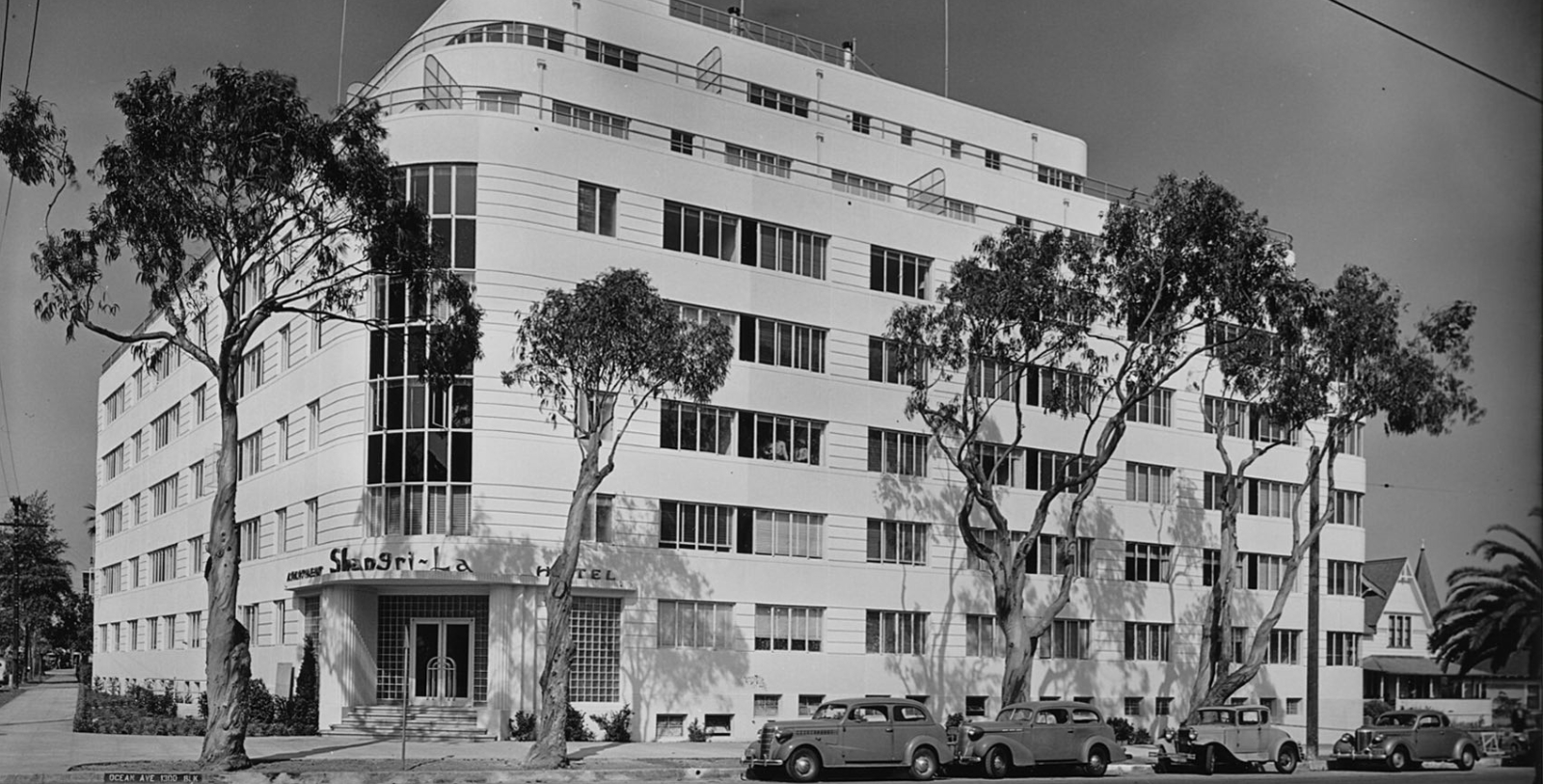
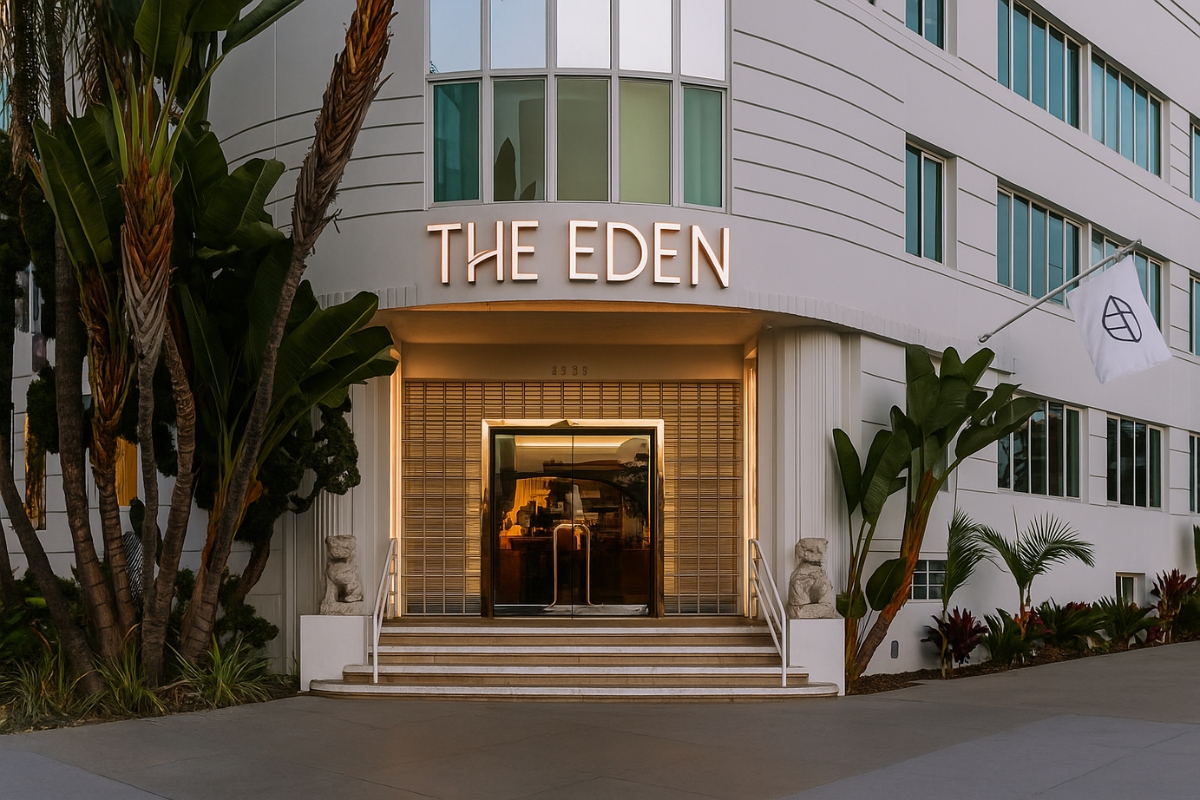
VIEW TIMELINEPerched along the sun-drenched curve of Ocean Avenue in Santa Monica, California, The Eden stands as a testament to the enduring allure of coastal elegance and architectural heritage. Though its current name evokes a sense of paradise, the building’s story is rooted in decades of transformation, reinvention, and cultural resonance. Originally opened toward the end of the Great Depression, the hotel began its life as the “Shangri-La Apartment Hotel”—a name inspired by the mythical utopia described in James Hilton’s novel Lost Horizon. The choice of name reflected the optimism and escapism of the era, especially with the world teetering on the outbreak of major global conflict. More specifically, the Tulsa-Santa Monica Corporation envisioned creating the hotel to provide local travelers with the uplifting refuge they so eagerly desired. To that end, the company hired architect William E. Foster to develop an outstanding hotel capable of radiating that kind of atmosphere. Foster’s vision materialized as a seven-story structure that seamlessly blended the aesthetics of Art Deco architecture with the glamour of the golden age of travel. (Foster was a proponent of Art Deco design, specializing in a version called “Streamline Moderne.”) Construction on the nascent structure began soon thereafter in 1939, taking a few months and $400,000 to finish.
However, the work that Foster—and contractors F.A. Gillespie & Sons—achieved was nothing short of spectacular. For instance, Foster had placed nine spacious double apartments on each of the first five floors, alongside a series of quaint studio-sized bachelor units. Further up, the structure resided dozens of incredible luxury suites, as well as two magnificent penthouses that sat atop its seventh—and final—floor. But these accommodations were not merely rooms—they were expressions of a lifestyle, offering sweeping views of the Pacific Ocean and the burgeoning cityscape of Santa Monica. As soon as America entered World War II though, the hotel’s role shifted dramatically. Indeed, the United States Army Air Forces repurposed the destination as a rehabilitation center, transforming its tranquil ambiance into a place of healing for countless servicemen. In the decades that followed the war, the Shangri-La Apartment Hotel subsequently resumed its place as one of the area’s most exclusive getaways. Its rooftop bar and ocean-facing suites attracted a constellation of celebrities, such as prominent Hollywood superstars like Mae West and Marilyn Monroe. The hotel’s cinematic appeal had made it a frequent backdrop for movie productions, starting with its appearance in the classic Film Noir One Girl’s Confession in 1953.
Then several decades later during the 1980s, prominent real estate tycoon Ahmad Adaya bought the site. Under Ahmad’s masterful stewardship, the hotel retained its boutique charm while gradually adapting to the changing tastes of contemporary guests. His effective leadership only further served to strengthen the location’s venerable reputation, as epitomized by its enduring popularity among all kinds of famous actors and actresses. More well-known films were shot within the structure, too, such as White Men Can’t Jump and The Net. Even President Bill Clinton visited the venue, staying on-site amid a wider trip to California scheduled in 1993! All the while, the business continued to thrive due to the accomplished leadership of the Adaya family, with Ahmad’s daughter—entrepreneur Tamie Adaya—assuming full managerial responsibilities in 2004. Her guidance went as far as to produce a period of revitalization for the structure, culminating in a $30 million renovation that occurred some four years later. This extensive overhaul preserved the building’s Art Deco soul while introducing innovative services and sustainable practices. Now known as “The Eden” today, this terrific historic hotel remains a steadfast symbol of both continuity and innovation. It is a place where the past flows seamlessly into the present, where travelers can find sanctuary and inspiration.
-
About the Location +
Located along Ocean Avenue in downtown Santa Monica, The Eden is just a few moments away from the famed Santa Monica Pier. A locally recognized historic landmark, Santa Monica Pier has entertained thousands of visitors since the early 20th century. It specifically debuted as the “Municipal Pier” on September 9, 1909, as part of a citywide building project to expand the Santa Monica waste management system. Even though the boardwalk offered no amenities at the time, it still managed to attract hundreds of guests due to its wonderful views of the Pacific Ocean. Sensing a great economic opportunity, Charles I.D. Looff and his son, Arthur, decided to develop the area into an exciting tourist destination. Purchasing a large plot of land immediately next to the Municipal Pier, they constructed their own boardwalk in 1916. Called the “Pleasure Pier,” it featured a wealth of carnival rides and games that guests could try. Its greatest attraction was the Pier Carousel, which the Looffs housed within the “Looff Hippodrome.” (Both the merry-go-round and its attending building are currently listed together as a U.S. National Historic Landmark.) Other activities involved navigating the winding corridors of a large funhouse, as well as riding on a wooden roller coaster called the “Blue Streak Racer.”
The Pleasure Pier continued to operate until 1923, when the Looff family sold their ownership stake to the Santa Monica Amusement Company. Filled with local entrepreneurs, the Santa Monica Amusement Company aspired to bring the Pleasure Pier into the national spotlight. They soon updated several of the rides, replacing the Blue Streak Racer with a faster roller coaster called “The Whirlwind.” They also installed several new facilities along the boardwalk, including the La Monica Ballroom. Designed by T.H. Eslick, the venue became the largest dance hall in the western United States. And with its 15,000 sq. ft. of hard maple flooring, it could easily accommodate up to 5,000 patrons. The Santa Monica Amusement Company managed to make the Pleasure Pier one of the region’s best holiday destinations by the end of the Roaring Twenties. But this prosperity was not to last, as the Great Depression significantly diminished visitation to the boardwalk. Most of the carnival exhibitions permanently shut down with their material sold off piecemeal. Fortunately, not all was lost for the area. Economic activity continued nonetheless, as a new breakwater began to offer space to publicly dock several dozen private boats in 1933. This new business would serve as the nucleus for the Santa Monica Yacht Club. Then, in 1938, the Works Project Administration built a new bridge and entry gate into the Municipal Pier.
Walter Newcomb then purchased the Pleasure Pier during World War II. Newcomb had been managing the site for several years and coveted the idea of owning the boardwalk for himself. His tenure as its owner saw the Pleasure Pier resume its status as the area’s most celebrated tourist attraction. As such, locals soon took to calling the area as the “Newcomb Pier.” Country musician Spade Cooley discovered the La Monica Ballroom and started broadcasting his weekly television program from its dance floor in 1948. The ballroom also hosted an exciting roller-skating rink that operated as the “Skater’s Ballroom” before becoming the “Santa Monica Roller Rink.” The venue debuted as the Hollywood Autocade in 1955, as well. It even displayed over 100 famous cars, including Jack Benny’s “Maxwell” and the Rumpler Drop Car. Meanwhile, two brothers—George and Eugene Gordon—started operating the boardwalk arcade at the behest of the Newcomb family. Their management of the business made it one of the most popular places at Newcomb Pier in just a matter of weeks. The arcade still exists and remains a major point of interest on the Santa Monica Pier.
The City of Santa Monica acquired the Newcomb Pier in 1974. Its city council intended to destroy the boardwalk to develop a manmade island that would house a private, 1500-room resort. Thankfully, residents banded together to form the “Save Santa Monica Bay” movement, which sought to save the historic pier from demolition. The furor was so immense that the city council backed down from its proposed plan. However, a massive storm swept through Santa Monica in 1982 and completely devastated the area. The city quickly rallied once more around saving the Newcomb Pier and began initiating repairs as soon as the storm subsided. After a eight-year-long process, the site was back to resembling its former glory. Most of the attractions had reopened as a single entity called “Pacific Park” by the mid-1990s. The Newcomb Pier and the Municipal Pier were then combined to form the current Santa Monica Pier. The area continues to be one of Santa Monica’s most memorable historic landmarks, as well as a source of community pride for the city. Truly no trip to Santa Monica is ever complete without a visit to this wonderful historic destination.
-
About the Architecture +
When architect William E. Foster first created the Hotel Shangri-La, he used an offshoot of Art Deco architecture known as the “Art Moderne” for its design. Art Moderne is a close relative to the Art Deco style of architecture that swept through the nation in the 1920s and 1930s. Like its cousin, the form originally emerged from a desire among architects to find architectural inspiration from previous historical examples. It specifically rejected the rustic, minimalism of the Arts & Crafts movement that had emerged around the same time. More importantly, they hoped that their ideas would better reflect the technological advances of the modern age. As such, historians today often consider Art Deco and Art Moderne to be a part of the much wider proliferation of cultural “Modernism” that first manifested at the dawn of the 20th century. Art Deco as a style that first became popular in 1922, when Finnish architect Eliel Saarinen submitted the first blueprints that featured the form for contest to develop the headquarters of the Chicago Tribune. While his concept did not win, they were widely publicized, nonetheless. Architects in both North America and Europe soon raced to copy his format, giving birth to Art Deco architecture. The international acceptance of Art Deco had risen so quickly that it was the central theme to the renowned Exposition des Art Decoratifs held in Paris a few years later.
But as the Great Depression surged throughout the United States in the early 1930s, American architects began to question the ostentatious nature of Art Deco design principles. Art Deco used a sleek, linear appearance that embraced ornate geometric decorations like chevrons and zigzags. But with the financial hardships of the depression constraining the budgets of architects worldwide, they started to “streamline” elements of Art Deco architecture into a more modest form. Called “Art Moderne,” this new variation of Art Deco relied upon an aerodynamic “pure-line” concept that reflected the reigning scientific attitudes about motion. The reason for adopting such ideals reflected the perception that modernity was unfolding at an unprecedented rate. Surfaces became plainer, while the exterior ornamentations were abandoned in favor of rounded lines and curves. Stucco served as the primary building ingredient for Art Moderne structures, although smooth-faced stone and polychromatic metals were utilized, too. Art Moderne typically called for smaller structures, which enabled architects to focus more on quality as opposed to quantity. But the geometric shapes of earlier Art Deco designs still appeared within Art Moderne buildings, albeit in a far humbler form. (For instance, towers were retained to present Art Deco’s emphasis on vertical design elements.) This approach to the Art Deco movement remained popular for some time, before giving way to the aesthetics of the 1960s.
-
Famous Historic Guests +
Mae West, actress known for her roles in She Done Him Wrong, I’m No Angel, and My Little Chickadee.
Marilyn Monroe, actress known for her roles in Bus Stop and Some Like It Hot.
Bill Clinton, 42nd President of the United States (1993 – 2001).
Elizabeth Taylor, film star and longtime cultural icon best known for her role in Cleopatra.
Brandon Lee, actor known for martial arts and roles in action films.
Bruce Weber, photographer and filmmaker, known for directing the documentary Let’s Get Lost.
Randy Newman, singer‑songwriter, known for his song “You've Got a Friend in Me” and “I Love L.A.”
Cybill Shepherd, actress, known for Taxi Driver and The Last Picture Show.
Diane Keaton, actress known for Annie Hall.
Arnold Schwarzenegger, actor and Governor of California (2003-2011).
-
Film, TV and Media Connections +
One Girl’s Confession (1953)
“I Love L.A.” – Randy Newman music video (1983)
White Men Can’t Jump (1992)
The Net (1995)
90210: Of Heartbreaks and Hotels (1998)
DiG! (2004)
Melrose Place: Ocean (2009)